
Why Bedford is Perfect for Solar Power
Bedford’s blend of open skies, varied property stock, and strong local appetite for sustainable living makes it an ideal place to invest in solar panels. Across Bedford and the wider Bedfordshire area, annual solar irradiation comfortably supports efficient generation, meaning a well-designed array can produce steady, predictable energy through spring, summer and even on many overcast days. In practice, a typical 4 kWp roof-mounted system in Bedford can often generate around 3,600–4,000 kWh per year under standard conditions, helping households and businesses cut daytime grid use and stabilise energy costs.
Aside from the environmental advantages—lowering your building’s carbon footprint and improving your EPC rating—solar offers compelling financial benefits. With daytime electricity prices remaining high and volatile, on-site generation offsets expensive imports from the grid. Many Bedford homeowners report bill reductions of 50% or more when combining panels with smart usage habits. Add a battery, and you can capture excess energy for use after sunset, pushing self-consumption higher and reducing reliance on peak-rate power. Export earnings via the Smart Export Guarantee (SEG) further enhance returns, paying you for the units you send back to the grid when you produce more than you use.
Policy and planning are generally supportive. Most roof-mounted installations fall under permitted development, provided the array sits within 200 mm of the roof plane and avoids restricted designations such as listed buildings. For systems up to 3.68 kW per phase, post-install notification to the Distribution Network Operator typically applies (G98). Larger arrays usually require prior approval (G99), which your installer should manage. For domestic customers, the current 0% VAT relief on qualifying energy-saving materials makes the upfront cost more approachable. Businesses in Bedford can also align solar with sustainability goals, CSR commitments, and energy-cost risk management, especially for sites with daytime operations and roof space to match.
Local conditions also favour practical design choices. Many properties in Bedford—the terraced streets, semis in Kempston, and larger detached homes in Great Denham—have south or southwest-facing roofs with minimal shading, a sweet spot for year-round yield. Even east-west orientations can be effective, often spreading generation to match morning and late-afternoon demand. Industrial units around Elms Farm or Woburn Road Industrial Estate typically offer large, unobstructed roof spans that handle higher-capacity arrays. For accredited design and installation of Solar Panels in Bedford, seeking local expertise ensures your system suits the property, grid, and day-to-day energy profile from the start.
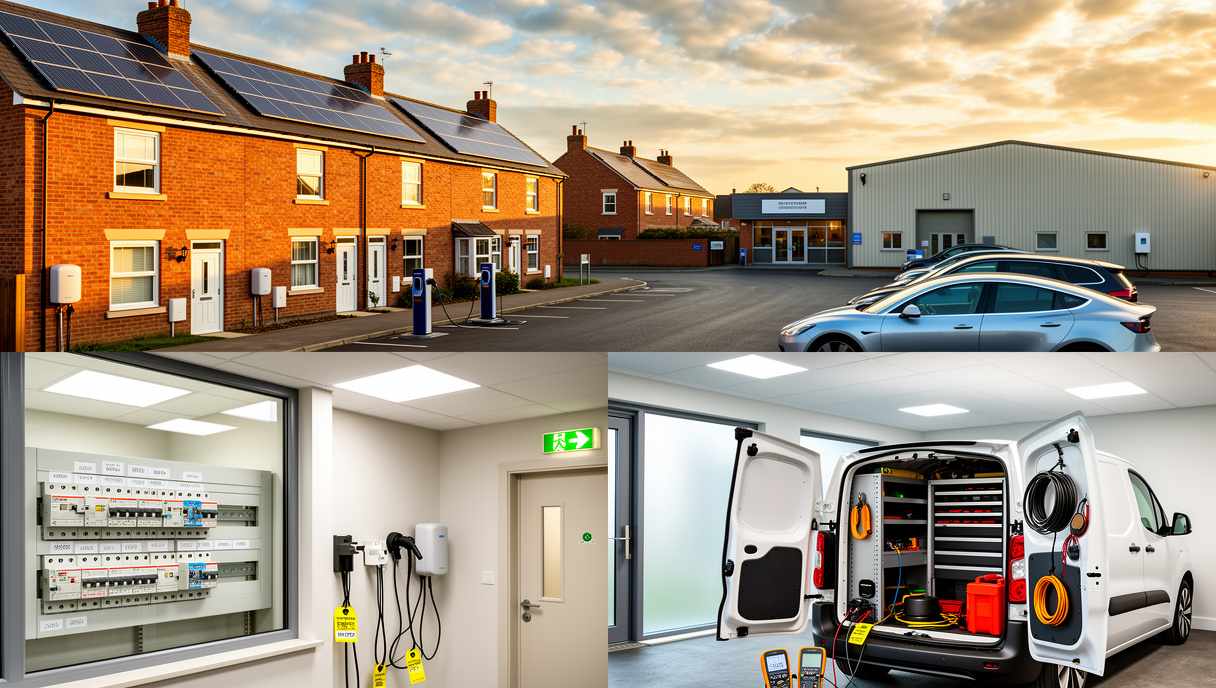
Choosing and Installing Solar Panels in Bedford: Roofs, Systems, and Storage
Getting the best from solar panels in Bedford begins with a tailored survey. A competent installer will measure usable roof area, check tilt and orientation, assess shading (chimneys, dormers, tall trees), and evaluate roof condition. If you’re planning to reroof, it’s often smart to align that work with your solar project. For slate, tiled, and flat roofs, there are tried-and-tested mounting systems designed to protect the roof envelope while meeting wind and snow loading requirements. In residential settings, arrays between 3 kWp and 6 kWp are common. Commercial properties might consider 10 kWp to 100 kWp+ depending on load profile and available space.
Component choices matter. High-efficiency monocrystalline modules maximise output from limited areas, and reputable brands typically offer 25-year performance warranties and 10–15-year product warranties. Inverters come in several types: classic string inverters provide cost-effective reliability, while power optimisers or microinverters help mitigate partial shading and module-level mismatch, improving energy harvest on complex roofs. Your installer should also discuss generation meters, export meters (where needed), isolators, surge protection, and monitoring platforms that let you track performance and identify issues early.
Battery storage is becoming a cornerstone of Solar Panels in Bedford projects. A 5–10 kWh battery can store midday surplus for the evening peak, boosting self-consumption and resilience. For homes with electric heating, immersion controls can divert surplus solar into hot water, increasing savings further. Businesses benefit from load-shifting and peak shaving, especially where machinery or refrigeration drives afternoon demand. If you own or plan to add an EV, integrating a compatible charger with solar control can prioritise charging from your roof generation, reducing running costs and carbon intensity.
From a process perspective, most domestic installations take 1–2 days on site after design approval and DNO notification or permission. Expect scaffold for safe access, followed by mounting, module fitting, DC and AC cabling, inverter commissioning, and handover with documentation. Good practice includes electrical testing, labelling, and system walkthroughs so you understand how to read outputs and use the monitoring app. Maintenance on modern arrays is modest—visual checks, occasional cleaning if dust or pollen accumulates, and keeping an eye on performance alerts. In Bedford’s climate, rainfall usually handles routine cleaning, but sites near busy roads or trees may need periodic attention. Reputable contractors will offer ongoing support, performance reviews, and advice on adding storage later if you want to stage the investment.
Planning nuances occasionally apply. In conservation areas or for listed buildings, you’ll likely need additional permissions; a discreet placement (rear roof slopes or integrated solar tiles) can help maintain visual harmony. Ground-mounts can be suitable for larger gardens or rural plots if roof space is limited, assuming you follow siting guidelines and trenching for cabling. Early conversations about export limits are also sensible; where the local grid is constrained, installers can fit export limitation devices to meet DNO requirements without sacrificing on-site consumption.
Costs, Savings, and Real Examples from Bedford Homes and Businesses
Costs vary with system size, component choice, access, and any electrical upgrades needed. As general guidance, many Bedford homeowners budget around £5,000–£7,500 for a 3–4 kWp array using reliable modules and a quality inverter. Stepping up to 5–6 kWp might land between £7,000 and £10,000 depending on roof complexity and shading mitigation. Battery storage typically adds £2,500–£6,000 for 5–10 kWh, with premium chemistries and extended warranties at the higher end. Commercial systems scale from sub-10 kWp packages for small offices to 50 kWp+ on light industrial roofs, with per-kWp costs benefiting from economies of scale.
Savings depend on when you use energy. Households at home during the day tend to self-consume a larger share, while those out at work gain more from batteries and smart scheduling. With sensible usage and a battery, many Bedford properties see 50–70% reductions in grid imports. Annual SEG export payments will vary by tariff and export volume; pairing solar with time-of-use tariffs and automation can further reduce costs. For businesses operating 9-to-5, solar generation aligns well with lighting, HVAC, IT, and process loads, often resulting in attractive payback periods and a hedge against future price shocks.
Consider a semi-detached home in Kempston with a 3.6 kWp array and a 5 kWh battery. Typical annual generation could sit near 3,400–3,800 kWh, with the battery capturing midday surplus for evening cooking, media use, and heating circulation pumps. By shifting energy intelligently—running the washing machine and dishwasher early afternoon—self-consumption rises, and grid reliance falls. Over the year, the household might cover a majority of its electricity use from the roof, with SEG earnings for exported units trimming payback further.
On the commercial side, imagine a light industrial unit on the Woburn Road Industrial Estate installing a 40–60 kWp system. Daytime generation helps power office equipment, compressors, and warehouse lighting. Forklift charging or process loads can be scheduled to soak up solar mid-shift, and if the site adopts a battery later, peak shaving can reduce exposure to higher demand charges and tariffs. The net effect: steadier operating costs, measurable CO2 reductions, and an uplift in the site’s sustainability credentials, which can support tenders and stakeholder engagement.
Warranties and aftercare complete the value picture. Quality modules often carry 25-year linear performance warranties, inverters 10–12 years (extendable), and batteries around 10 years subject to cycle and throughput limits. Robust design at the outset—balanced strings, appropriate cable runs, ventilation for inverters, and clear labelling—reduces downtime and protects returns. Monitoring portals let you see daily yield, battery state-of-charge, and export volumes, making it easier to identify anomalies before they affect savings.
Finally, keep an eye on complementary upgrades. LED lighting retrofits, insulation improvements, and smart controls multiply the benefits of solar by trimming baseline consumption. EV charging integrated with solar can turn surplus generation into fuel for commuting. For many Bedford properties, the most cost-effective route is phased: start with a right-sized PV array, then add storage or EV integration when budgets or needs evolve. With strong local expertise, transparent quotes, and systems built to current standards, Solar Panels in Bedford offer a practical pathway to lower bills, lower carbon, and greater energy independence.

Quito volcanologist stationed in Naples. Santiago covers super-volcano early-warning AI, Neapolitan pizza chemistry, and ultralight alpinism gear. He roasts coffee beans on lava rocks and plays Andean pan-flute in metro tunnels.
