
Roots, Regions, and Styles: A Continent’s Carved Heritage
Across North America, artists have long turned to the forest as both steward and storyteller, finding in each ring of wood an archive of memory. Native American wood carving encompasses a wide range of practices, from monumental poles that anchor community histories to intimate objects meant to guide personal reflection or ceremony. While materials, motifs, and techniques vary by region and Nation, the unifying thread is a commitment to place—carving as an expression of kinship with the land, waters, and beings that sustain life.
On the Northwest Coast, carvers from Nations such as Haida, Tlingit, Tsimshian, Kwakwaka’wakw, Nuu-chah-nulth, Heiltsuk, and Coast Salish often work with western red cedar and yellow cedar. Cedar’s straight grain, durability, and spiritual importance make it ideal for house posts, monumental poles, masks, feast bowls, and bentwood boxes. Distinctive visual languages emerge in this region, including the renowned formline system of ovoids and U-forms that give life to crest beings such as Raven, Eagle, Wolf, Salmon, Bear, and Killer Whale. These are not mere decorations; they are emblems of lineage, rights, and responsibilities, situated within specific community protocols. In coastal communities from Alaska through British Columbia and down to Washington State, the tidal rhythm, salmon runs, and cedar groves shape not only the material but also the meaning of each carving.
Elsewhere on the continent, wood carving reveals a similarly deep regional resonance. In the Southwest, Hopi artists carve katsina (katsinam) figures from cottonwood root, whose generous, interlaced fibers are prized for their stability and spiritual associations. These carvings convey teachings and seasonal cycles, bridging home and ceremony. In Alaska and the Subarctic, Yup’ik and other Indigenous carvers historically created complex dance masks, sometimes with moving elements that animate a story during performance. In the Eastern Woodlands, Haudenosaunee carvers address healing and community roles through masks and careful, time-honored protocols, while Wabanaki artists shape canoe paddles and tools that reflect riverine life. Great Lakes and Plains regions feature carved pipe stands, effigies, drum frames, game pieces, and utilitarian objects elevated by elegant design and precise toolwork.
From grand cedar poles that rise against the Pacific mist to a katsina figure held gently in the palm, each piece weaves together function, form, and cosmology. Carving is a living practice, evolving with new materials and tools yet grounded in ancestral knowledge. Contemporary artists experiment with scale, color, and multimedia in ways that speak to today’s conversations—sovereignty, language revitalization, environmental stewardship—while honoring teachings passed forward by Elders and mentors.
Tools, Techniques, and the Language of Form
Understanding how a carving is made illuminates why it looks and feels the way it does. The process often begins long before the first cut. Knowledgeable carvers select wood with intention, reading the grain for movement and stability. On the coast, straight-grained cedar—harvested respectfully and legally—offers resilience in wet climates and cooperates under tools to reveal fluid lines. Alder, maple, and yew appear in smaller works, while cottonwood root in the Southwest lends itself to intricate shaping without excessive splitting. Many artists season their material or rough out the form and allow it to rest, aligning the carving’s internal stresses with the intended design.
Traditional tools remain central. The adze—ranging from elbow adzes for heavy hewing to D-adzes for surface refinement—creates the rhythmic, faceted planes seen on monumental poles and masks. Crooked knives and carving knives establish contours, undercuts, and crisp edges; gouges and chisels open up bowls or deepen relief. Some artists integrate power tools for efficiency on large-scale works, yet the final passes often return to hand tools to preserve the tactile “knife finish” that gives a piece its visual vitality. Inlay materials like abalone, operculum, and shell provide luminous highlights, while paints—once ground from mineral and botanical pigments and today often acrylic—amplify form and story.
Design frameworks shape how viewers read the narrative. On the Northwest Coast, formline is a grammar: line weight shifts to suggest muscle and motion; ovoids anchor eyes and joints; U-forms curve into fins, feathers, and tongues. The discipline lies in knowing when to open space and when to interlock shapes, guiding the eye along a path that unfolds character and relationship. Elsewhere, the “language” takes other forms: the balanced, dignified planes of Hopi katsinam; the dynamic, sometimes kinetic elements in Yup’ik masks; or the sculptural economy of Eastern Woodlands works that combine symbolic potency with refined restraint.
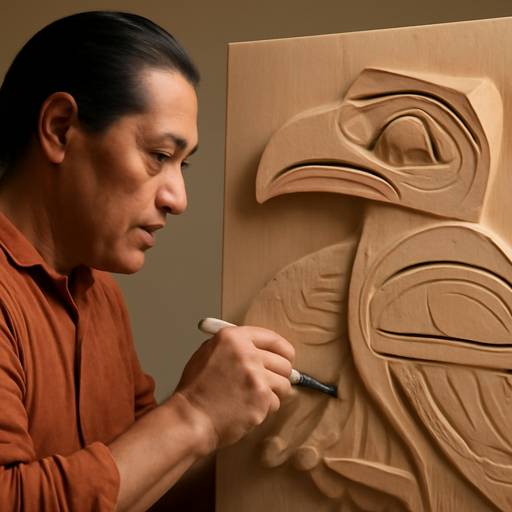
Joinery and shaping techniques carry their own ingenuity. Steam-bending transforms a single cedar plank into a bentwood box without corner seams, its integrity maintained by a tight, heated curve and precise lacing or pegging. Undercutting in masks and relief panels adds shadow and presence, while knife-finished facets catch light like ripples on water. Each technical choice supports meaning and use—whether a bowl made to serve guests at a feast, a house post bearing stories of a family, or a dance mask enlivened by movement and song.
Respect for cultural rights and ecological balance is integral to contemporary practice. Certain designs and crest figures are owned by particular families or communities, and responsible artists follow protocols and permissions. Sourcing wood from storm-fallen trees, sustainably managed forests, or dedicated salvage supports long-term stewardship. Apprenticeship, workshops, and community carving programs pass knowledge forward so that both technique and tradition remain strong. To appreciate this depth and diversity, explore thoughtfully curated examples of Native American wood carving, noting how material, purpose, and place are inseparable in each piece.
Collecting, Caring For, and Supporting Living Traditions
Thoughtful collecting begins with ethics and authenticity. Seek Native-owned galleries, trading posts, and direct relationships with artists and their communities. Documentation matters: look for the carver’s name, Nation or community affiliation, materials used, and when possible, the story or purpose carried by the design. Beware of mass-produced imitations—particularly those that borrow Indigenous aesthetics without community consent. Authentic pieces not only hold cultural value and artistic merit; they uphold livelihoods, sovereignty, and the continuity of teachings across generations.
Care and display practices help carvings thrive for decades. Wood responds to its environment, so steady relative humidity—often in the 40–55% range—reduces cracking and warping. Avoid direct sunlight and concentrated heat sources like radiators or fireplace mantels, which can dry wood unevenly. For routine cleaning, a soft, dry brush or microfiber cloth removes dust without abrading surfaces; skip oils, waxes, or commercial cleaners unless the artist specifically recommends them. When mounting wall panels or masks, use hangers or French cleats sized to the work, distributing weight and allowing the piece to expand and contract naturally. During transport, cushion carvings with acid-free tissue and clean padding; double-boxing adds protection. Allow objects to acclimate to new environments gradually, especially in winter or in coastal climates where temperature and humidity shift quickly.
Commissioning a bespoke work is a meaningful way to connect with place and lineage. Consider a real-world scenario: a household on Coast Salish lands along the Salish Sea seeks a cedar panel for a foyer. The family consults a local artist, shares what motifs resonate—perhaps Salmon for sustenance, a spindle whorl to honor weaving, or an abstracted river current to reflect their home’s location. Measurements and placement guide scale; the artist discusses wood selection, whether western red cedar or yellow cedar suits the light and interior climate. Sketches refine the balance of positive and negative space; timelines accommodate design, carving, finishing, and safe installation. On completion, the family may choose to acknowledge the artist publicly and, when appropriate, invite a blessing or land acknowledgment to honor the relationship among artwork, maker, and territory.
Community support extends beyond individual purchases. Regional exhibitions, cultural gatherings, and seasonal markets—throughout British Columbia, the Pacific Northwest, and broader North America—offer opportunities to meet artists, learn protocols, and see how carvings live within dance, song, and ceremony. Retailers and cultural organizations can engage ethically by working with Native-owned wholesalers, ensuring fair payment, crediting artists by name and Nation, and sharing accurate information with visitors. Educators and designers can foster respectful collaborations, making space for carvers to speak to meaning, materials, and community contexts in their own voices.
Above all, approach collecting and display with humility. Wood is not inert; it breathes with climate and carries the wisdom of hands that shaped it. When sourced responsibly and acquired with respect, Native American wood carving becomes more than decor. It is a living relationship—honoring Elders and mentors, supporting artists today, and opening pathways for future generations to learn, create, and carry these stories forward.

Quito volcanologist stationed in Naples. Santiago covers super-volcano early-warning AI, Neapolitan pizza chemistry, and ultralight alpinism gear. He roasts coffee beans on lava rocks and plays Andean pan-flute in metro tunnels.

Leave a Reply